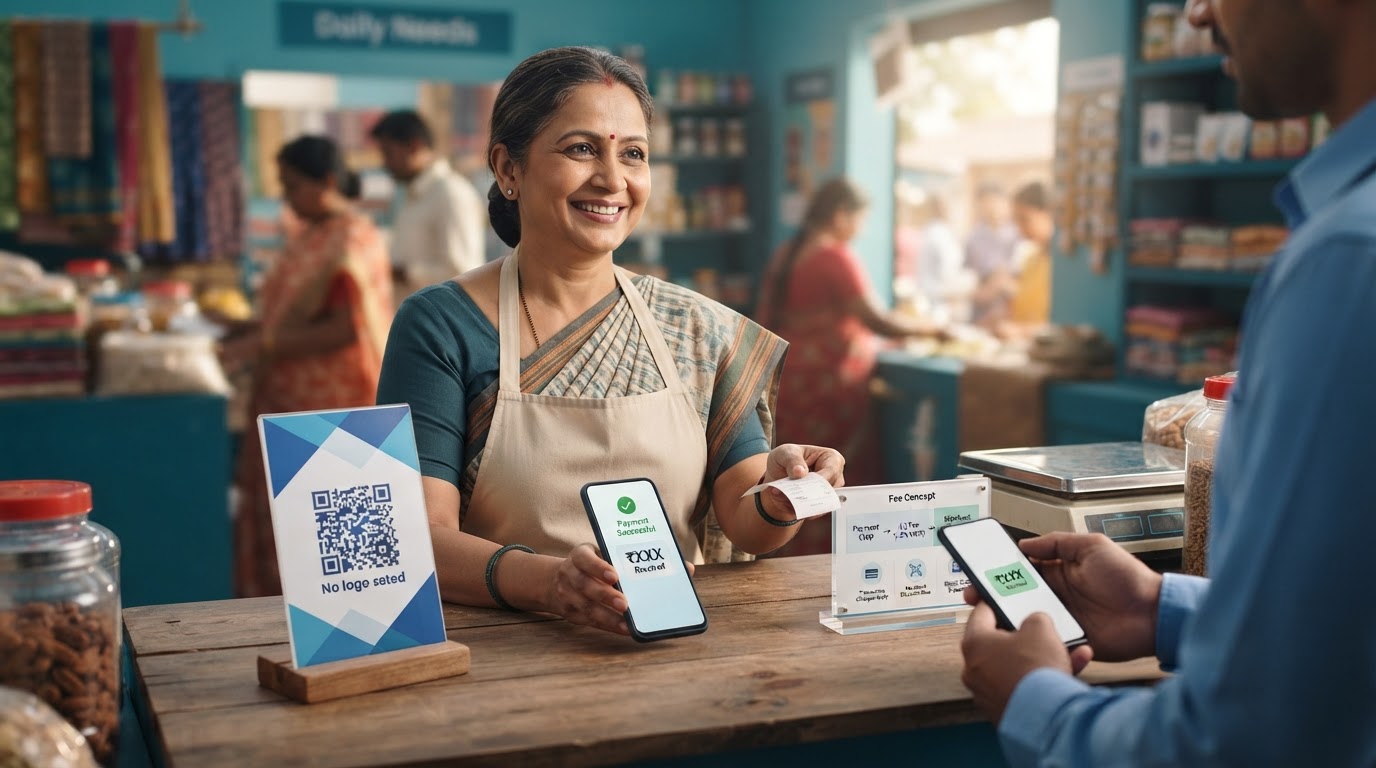
If you regularly pay by scanning a QR code, the phrase “UPI charges” can sound alarming. The important point is that the new framework does not introduce a fee for ordinary users sending money or paying merchants through UPI. The change is mainly about how certain merchant transactions are priced inside the payments ecosystem.



Update — 10 October 2026: The October 15 rollout was the previously announced schedule. A Reuters report dated October 8 says officials are considering postponement, potentially until January 2027, and that a final decision was still pending at publication. Check the latest NPCI and government announcements before relying on an effective date.
Under the previously announced timetable, from October 15, 2026, a Merchant Discount Rate (MDR) would apply to specified person-to-merchant UPI transactions above ₹2,000. The Ministry of Finance has clarified that person-to-person transfers remain free, consumers should not be charged for making UPI payments, and most merchant transactions will continue to remain outside the new MDR framework.
This matters because headlines about “UPI charges” can easily create the impression that every QR payment will suddenly cost extra. That is not what the announced rules say. The details depend on who is receiving the payment, the transaction value, and the merchant category.
What is changing with UPI MDR in 2026?
MDR, or Merchant Discount Rate, is a payment-processing charge paid within the merchant payments ecosystem. It is generally associated with the cost of processing digital payments and is shared among participants such as acquiring banks, payment service providers and payment applications.
Under the new UPI framework, the standard rate for eligible person-to-merchant transactions above ₹2,000 is 0.4%. For transactions of ₹75,000 or more, the MDR is capped at ₹300 per transaction.
The Finance Ministry has also said the MDR is not a tax collected by the government or NPCI. It is a commercial payment-processing charge within the UPI ecosystem.
Will normal UPI users have to pay a fee?
For ordinary consumers, the answer is no under the announced framework.
- Person-to-person UPI transfers remain free, regardless of the amount.
- Customers making merchant payments are not supposed to pay the MDR.
- UPI app providers are not supposed to add hidden platform charges for these customer payments.
- Normal bank and NPCI transaction limits remain security and risk-management limits, not fee thresholds.
So, if you send ₹5,000 to a family member through UPI, this new MDR framework does not turn that transfer into a paid transaction. Likewise, if you pay a merchant, the MDR is a merchant-side payment cost rather than a customer transaction fee.
Which merchant payments will attract MDR?
The standard rule applies to specified person-to-merchant (P2M) UPI payments above ₹2,000. The announced standard rate is 0.4%.
Here are simple examples:
- A qualifying ₹3,000 merchant payment at 0.4% would create an MDR of ₹12.
- A qualifying ₹10,000 merchant payment would create an MDR of ₹40.
- A qualifying ₹50,000 merchant payment would create an MDR of ₹200.
- At ₹75,000, 0.4% equals ₹300.
- For larger qualifying transactions above ₹75,000, the cap keeps the MDR at ₹300.
These examples show the merchant-side processing cost. They are not amounts a consumer should automatically see added to the bill.
Which UPI payments remain free?
The Finance Ministry says the vast majority of UPI transactions will remain unaffected.
1. Person-to-person transactions
Transfers between individuals remain free. Sending money to friends, family members or another person through UPI does not attract this merchant MDR.
2. Merchant payments up to ₹2,000
Person-to-merchant payments up to ₹2,000 continue under the zero-MDR framework.
3. Eligible small merchants
The government has said small merchants, including street vendors receiving up to ₹1 lakh per month through qualifying UPI QR payments under the P2PM category, continue to receive zero-MDR treatment.
This is an important distinction because a small neighbourhood seller is not treated the same way as every larger commercial merchant simply because both accept a QR payment.
Special sectors have different treatment
The standard 0.4% rate is not the only rule. The government has announced special treatment for certain sectors.
For essential and thin-margin categories such as railways, telecommunications, insurance, fuel and agricultural inputs, qualifying transactions above ₹2,000 are subject to a flat MDR of ₹5 rather than the standard percentage rate.
Capital-market related payments, including certain payments connected with mutual funds, securities, stockbrokers and dealers, have a lower announced MDR of 0.02%, subject to a ₹300 cap.
Because payment classification matters, merchants should check how their acquiring bank or payment provider has classified their business rather than relying only on a general headline.
Can merchants simply add the MDR to the customer’s bill?
The Finance Ministry has said banks have been advised to ensure that merchants do not pass the MDR charge on to customers. The stated policy is that individuals should continue to use UPI without a customer-side transaction fee.
That does not mean prices across the economy can never change. A business may review its overall pricing when costs change, just as it does with rent, logistics or other expenses. But a merchant should not present the UPI MDR as a direct mandatory UPI fee that the customer is required to pay under the new framework.
Does splitting one payment into smaller UPI payments avoid MDR?
Trying to split a large commercial payment into multiple smaller payments just to stay below the threshold is not a sensible strategy.
Payment providers can look at transaction patterns and commercial context, and deliberate fragmentation may create operational or compliance issues. More importantly, customers do not gain anything from doing this because the MDR is not meant to be charged to the customer in the first place.
For merchants, the better approach is to understand their merchant category, monthly payment profile and acquiring-bank terms rather than trying to restructure a genuine single purchase into artificial smaller payments.
What should small businesses do before October 15?
If you accept a significant number of UPI payments, a few basic checks can prevent confusion:
- Confirm your merchant classification. Ask your acquiring bank or payment provider whether you fall under the standard P2M category, a small-merchant category or a special sector.
- Check settlement statements. After the framework takes effect, compare the gross payment value with the net settlement amount so you understand any MDR deduction.
- Do not assume every payment above ₹2,000 is treated identically. Sector-specific and merchant-specific rules matter.
- Train staff not to invent a customer UPI surcharge. A cashier should not tell a customer that “UPI now costs 0.4%” because that is misleading.
- Keep payment records. Accurate transaction records make it easier to reconcile settlement deductions and raise disputes with your acquiring bank.
What does this mean for consumers?
For most users, very little changes at the checkout screen. You can still use UPI for everyday payments without a customer-side MDR.
The practical advice is simple: if a merchant claims that every UPI payment above ₹2,000 now carries a mandatory customer fee, ask for clarification. The government framework says the MDR sits within the merchant payment ecosystem and consumers are not supposed to bear it as a UPI transaction charge.
If you prefer comparing payment methods for rewards, remember that UPI and credit cards solve different needs. Credit cards may offer cashback, travel rewards or interest-free periods, while UPI is primarily valued for simple bank-to-bank payments. You can also read our guides to cashback credit cards in India, lifetime-free credit cards, and credit cards for online shopping if you are comparing alternatives.
Why has UPI introduced merchant MDR now?
The government has described the framework as a way to support the long-term sustainability of the UPI ecosystem while protecting consumers and small merchants. Processing billions of payments requires banking infrastructure, fraud controls, customer support, cybersecurity, network capacity and continuous technical investment.
The policy attempts to keep everyday and peer-to-peer usage free while allowing a limited commercial charge on selected higher-value merchant payments.
Quick summary
- The new UPI MDR framework is scheduled to take effect from October 15, 2026.
- Person-to-person UPI transactions remain free.
- Consumers are not supposed to pay the MDR on merchant transactions.
- Specified P2M transactions above ₹2,000 attract a standard MDR of 0.4%.
- The standard MDR is capped at ₹300 for transactions of ₹75,000 and above.
- Small merchants and certain sectors receive different or exempt treatment.
- Essential sectors have an announced flat ₹5 MDR on qualifying transactions above ₹2,000.
Final takeaway
The most important thing to understand is that “UPI MDR” does not mean “UPI is no longer free for users.” The 2026 change is mainly a merchant-payment pricing framework. For consumers, ordinary UPI usage remains free under the announced rules. For businesses, the real task is to understand which merchant category applies and how the acquiring bank will reflect the charge in settlement statements.
Because payment rules can be updated, merchants handling high transaction volumes should also check their bank or payment provider’s latest circulars before changing billing or accounting processes.
Sources and further reading
- Ministry of Finance: UPI remains free for P2P transactions and most merchant transactions
- NPCI MDR implementation details and October 15 effective date